Augmented Reality is more than Virtual RealityLatest tech hints
This page will continue to fill with new technology ideas as they appear.
Towards Wearable, High-Performance
Augmentd Reality Displays:
Currently, AR glasses with half the eye resolution and a tiny field of view and a small eyebox requiring helmet-like head mountings, are still hyped as progress. But AR needs way better technology, it should be as light and convenient as the best state-of the-art eyeglasses, deliver high resolution and a very large field of view.
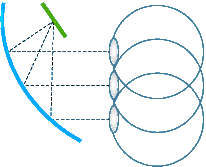
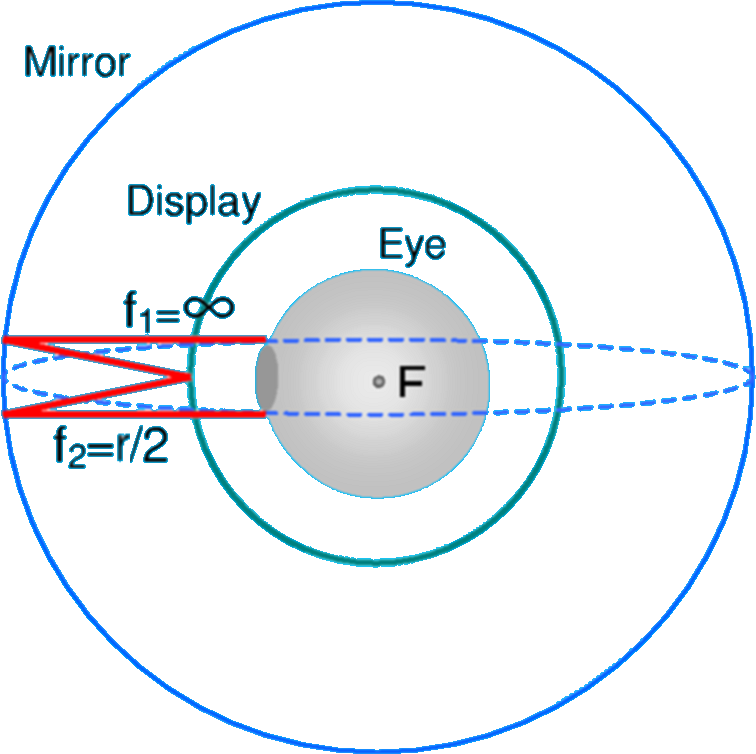
In this paper (latestPDF; web page version), we propose curved and translucent on-axis-displays as a perfect solution, fulfilling all of the requirements*.
A complete developer toolkit with detailed math, Blender 3D models and tutorial videos can be downloaded here, as well as from displaysbook.info.
* All rights preserved. Patents granted. DE102014013320B4; GB2537193B, US11867903B2.
Displays delivering high resolution while covering a wide field of view are difficult to build, as this requires way above even QFHD resolution, and the computing power necessary to render such images in 3D and real time is not yet easily integrated into mobile devices. We also need very high frame rates if we want a convenient motion response, especially when combined with high resolution.
The Answer to this could be intelligent display chips. This is an entirely new concept. Click to read more...
Mobile phone 'AR' apps, just at the horizon when the current book edition was finished, have meanwhile appeared in numbers and created new interest in AR as a general topic. Yet, these apps are just decorating displayed information with a more or less properly aligned camera image of the scene. All is trapped in the phones display, and hands-free operation is not possible.
Nevertheless, if we could just use some simple display glasses as routinely as we use headphones, the information could really be integrated to sight. The optical functionality needed is no more than that of a headup display - ancient technology already, and simple as well. Click to read more...Combining the collimated mode with a concept of 'dumb' display glasses opens up new aspects also for indoor applications, foremost virtual large panel TVs but also many other types of virtual devices. Architectural concepts and the achievement of lowest possible power consumption and weight for the display glasses are paramount issues in this context. Click to read more...
Adaptation:Despite all possible simplifications, dynamic fit and focus adaptation will be important for really versatile AR displays, and there are several promising technologies for it. For instance, have a look at these materials about artificial muscles.
* patents pending
Optics w. concentric mirror and display spheres
Spherical transparent display (pixels extremely enlarged)
home news
Copyright © 2006-2011 Rolf R. Hainich; all materials on this website are copyrighted.
Disclaimer: All proprietary names and product names mentioned are trademarks or registered trademarks of their respective owners. We do not imply that any of the technologies or ideas described or mentioned herein are free of patent or other rights of ourselves or others. We do also not take any responsibility or guarantee for the correctness or legal status of any information in this book or this website or any documents or links mentioned herein and do not encourage or recommend any use of it. You may use the information presented herein at your own risk and responsibility only. To the best of our knowledge and belief no trademark or copyright infringement exists in these materials. In the fiction part of the book, the sketches, and anything printed in special typefaces, names, companies, cities, and countries are used fictitiously for the purpose of illustrating examples, and any resemblance to actual persons, living or dead, organizations, business establishments, events, or locales is entirely coincidental. If you have any questions or objections, please contact us immediately. "We" in all above terms comprises the publisher as well as the author. If you intend to use any of the ideas mentioned in the book or this website, please do your own research and patent research and contact the author.